
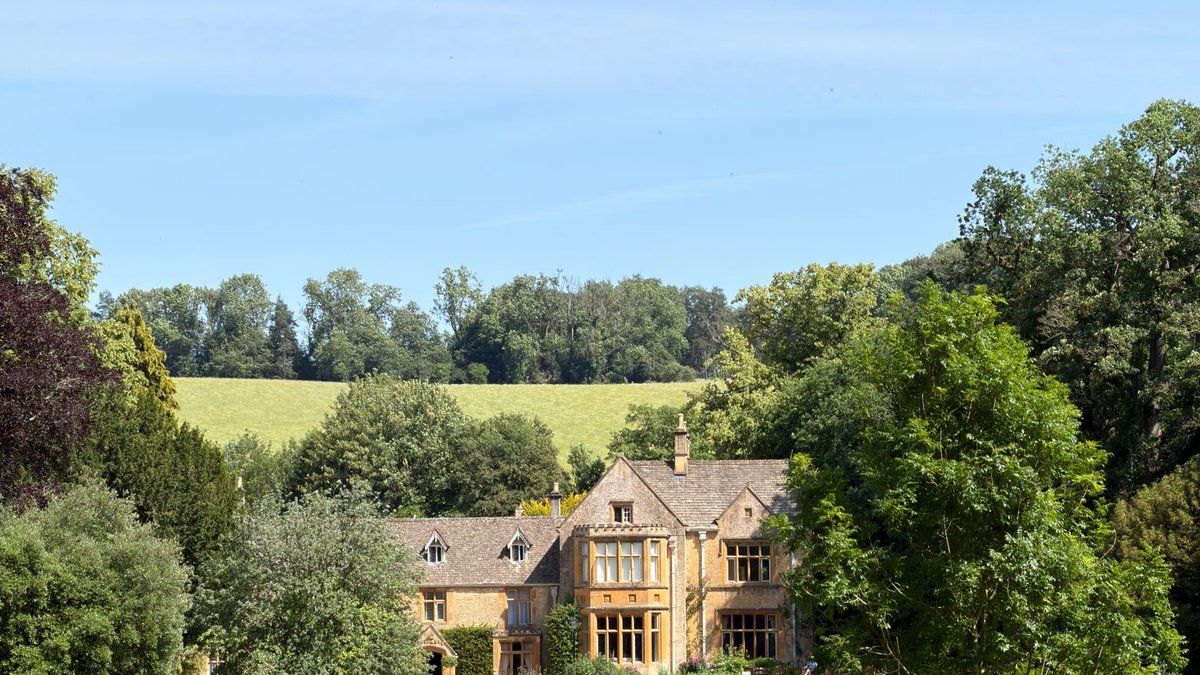
A historic estate spanning 230 acres in England’s posh Cotswolds region is now on the market seeking offers in the £20 million to £30 million (US$26.9 million to US$40.4 million) range. The history of Rendcomb Park, in Gloucestershire’s Churn Valley, goes back to at least the 11th century, before the Norman Conquest, according to Knight Frank, which began marketing the listing this week.
For centuries, the estate was owned and occupied by prominent families, and in 1919, the property was acquired by educational philanthropist Frederick Noel Hamilton Wills, who turned it into a private school named Rendcomb College. The school was in operation until the end of this past school year, when it closed because of insurmountable financial pressures.
The net proceeds of the sale will be donated to the educational charity the Farmington Trust, continuing “the Rendcomb legacy by supporting front-line education and benefiting new generations of children,” according to Knight Frank. The Farmington Trust was also established by a member of the Wills family, Robert “Bobby” Wills.
When my great-grandfather, Noel Wills, chose Rendcomb Park as a suitable site to found a school, he was immediately struck by the quality of the architecture set within the beautiful park setting. He knew it would provide the ideal base to realize his vision to create excellent educational opportunities for Gloucestershire children, regardless of their means.
Related: Revolutionary War Homes Hit Market
The brokerage is now marketing Rendcomb Park to wealthy private buyers seeking a grand country estate or investors interested in alternative uses.
The estate’s multiple buildings offer about 191,000 square feet of space, and its central structure is a Grade II*-listed manor house, which was rebuilt from 1863-65 for Sir Francis Goldsmid, an English politician and lawyer. The Italianate-style manor stands on an raised site that gives it panoramic south-facing views across the estate’s grounds and the surrounding setting.
Inside, the home has 32,000 square feet of living space. Additional structures include 12 cottages and houses, plus the Grade II-listed Old Rectory and a French Renaissance-style stable block. Its extensive grounds include acres of parkland and woodland, as well as formal gardens, a walled garden, a deer park and playing fields.
“Opportunities to acquire estates of this magnitude and stature are exceptionally limited,” said Emma Cleugh, head of education and charities at Knight Frank, who is the lead agent on the listing. “The scale and diversity of the property, including the main mansion and secondary houses, cottages and outbuildings, means it will have broad appeal to a wide range of buyers.”


